The best sectional layout depends on three things: the room's focal point (a TV, fireplace or view), the paths people walk through the room, and the shape of the space. In most living rooms an L-shaped sectional works best tucked into a corner or floated to define a seating zone, with 30–36 in (76–91 cm) of walkway around it and a rug large enough for the front legs of every piece.
Below are eight layouts that work, the clearances behind them, and how to place the chaise and size the rug.
Key points
- Point the long side of the sectional at the main focal point and put the chaise or short return on the side away from the entrance.
- Keep main walkways 30–36 in (76–91 cm) wide and leave 14–18 in (36–46 cm) between the seat and the coffee table.
- Most L-shaped sectionals need an 8 x 10 ft (244 x 305 cm) rug or larger; big U-shapes often need 9 x 12 ft (274 x 366 cm) or more.
- A sectional can float in the room if its back is upholstered and there is walking space behind it.
- Tape the footprint on the floor before you buy or rearrange anything.
In this guide
Before you choose a layout
A little planning saves a lot of shoving furniture around:
- Find the focal point. Decide what the seating should face: the TV, a fireplace, a view or each other.
- Map the traffic. Mark every doorway, the route between them and any door that swings into the room. The sectional should sit beside these paths, not across them.
- Note the fixed obstacles. Radiators, vents, outlets, low windows and built-ins all limit where a long piece can go.
- Measure the room and the sofa. Note the length of each side of the sectional and its depth, including the chaise. Our guide on how to measure for a sofa also covers doorways and stairs.
- Tape it out. Mark the outline with painter's tape and live with it for a day. Walkway problems show up immediately.
Clearances that make a layout work
| Space | Recommended distance |
|---|---|
| Main walkway (between doors, around the seating) | 30–36 in (76–91 cm) |
| Secondary path (behind a chair, to a side table) | At least 24 in (61 cm) |
| Seat edge to coffee table | 14–18 in (36–46 cm) |
| Sectional to a 4K TV | About 1–1.5 times the screen diagonal, roughly 5.5–8 ft (1.7–2.4 m) for a 65 in TV |
| Back of a floating sectional to a wall or furniture, when people walk behind it | 30–36 in (76–91 cm) |
| Sectional to the wall behind it | 2–3 in (5–8 cm) to avoid scuffs and leave room for curtains |
| Rug edge to the walls | 12–18 in (30–46 cm) of visible floor |
Coffee tables for sectionals are usually square, round or oval so that people on both sides of the L can reach them. Keep the tabletop level with the seat or 1–2 in (2.5–5 cm) lower; our coffee table height guide explains the details.
8 sectional sofa layout ideas
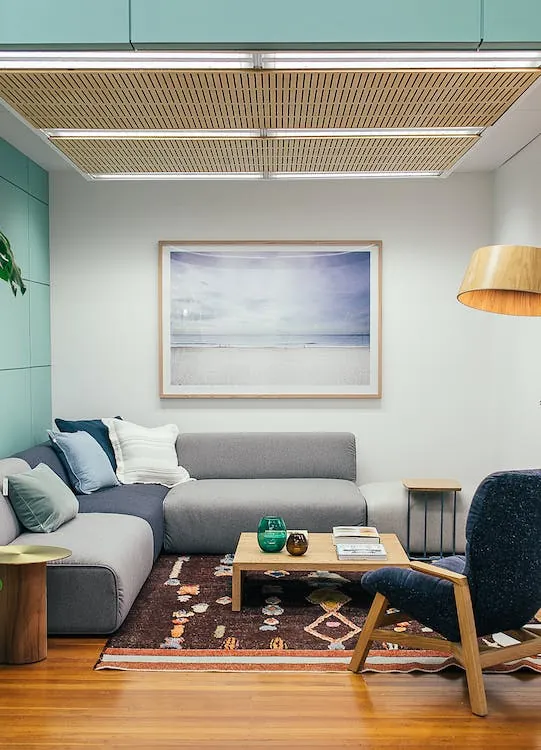
1. L-shape in a corner
The classic layout. An L-shape pushed into a corner frees the rest of the floor and works best in square and medium-sized rooms. If a radiator or vent sits in the corner, pull the sofa forward and fill the space behind it with a corner table or floor lamp.
2. L-shape facing the TV
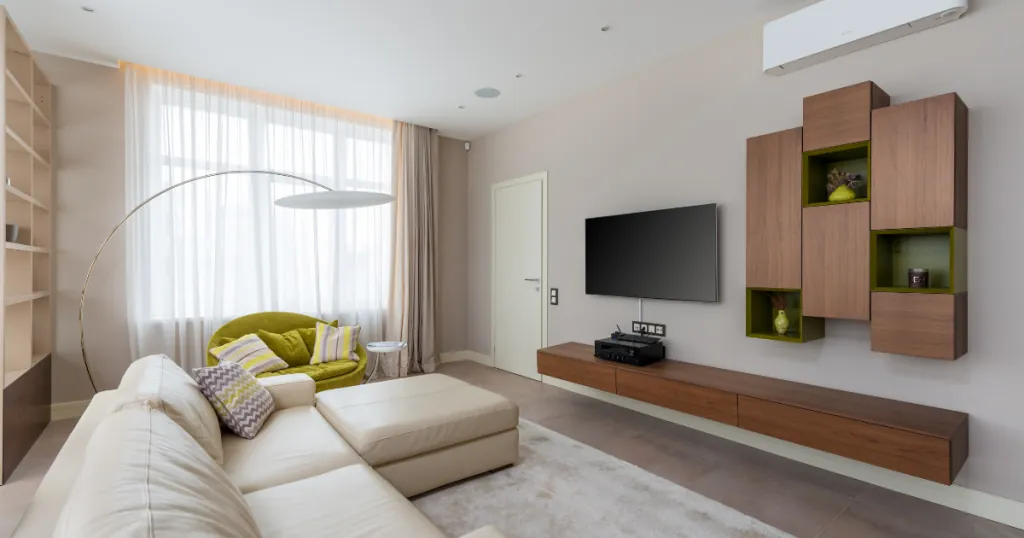
Set the long side parallel to the TV wall and run the shorter return or chaise along a side wall. Nobody sits with their back to the screen, and the corner seat still has a reasonable viewing angle. Center the TV on the long side rather than on the whole L, and mount it so the middle of the screen is roughly at seated eye level.
3. Floating sectional in an open-plan room
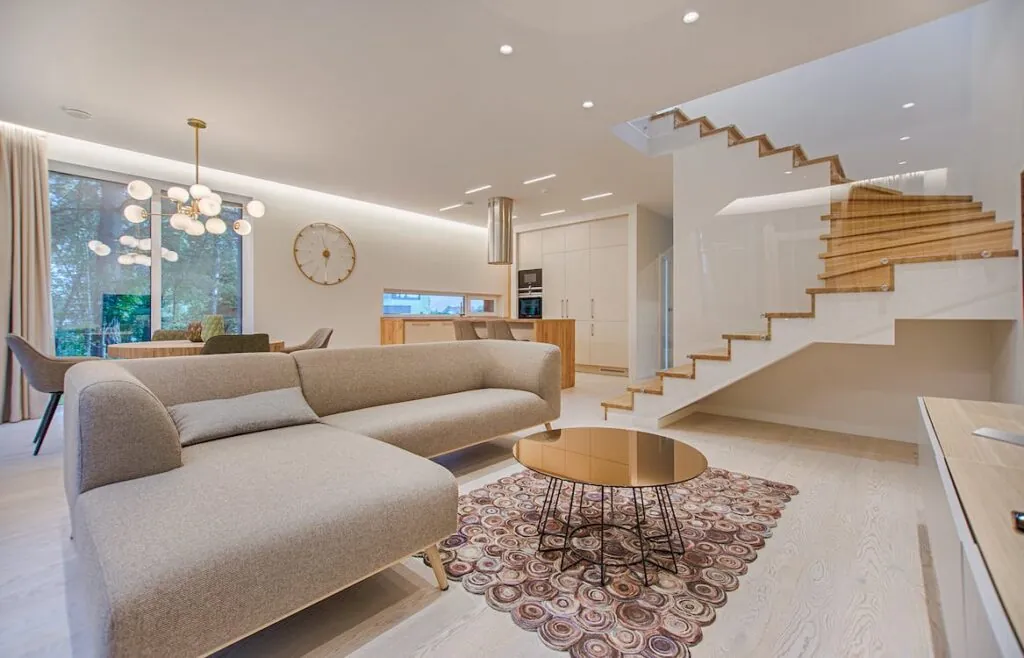
In an open space, place the sectional away from the walls with its back toward the kitchen or dining area. It defines the living zone without a partition and lets traffic flow behind it. Anchor it with a large rug and add a console table behind it, at or just below the height of the sofa back, for lamps. This only works if the back is fully upholstered.
4. Chaise sectional in a small room
A chaise gives you room to stretch out without the footprint of a full L. Put it on the side away from the door, and choose low arms and raised legs that show the floor so the piece feels smaller. See our guide to sofas for small spaces for more size tips.
5. U-shape for a large family or media room
A U-shape seats the most people and feels cozy and enclosed, but usually needs a room wider than about 13 ft (4 m). Face the open end toward the TV or fireplace, use a large ottoman or two coffee tables in the middle, and keep the opening wide enough to walk through comfortably.
6. Sectional plus chairs for conversation
One or two armchairs opposite an L-shape complete a square seating group, which is better for talking than a sectional alone. Keep the chairs within reach of the coffee table and leave at least 24 in (61 cm) behind them.
7. Sectional with a fireplace and a TV
If the TV hangs above the fireplace, the long side faces both, but sit far enough back that you don't have to tilt your head up. If they are on different walls, let the long side face one and the return face the other.
8. Sectional in a long, narrow room
Instead of lining a long wall, use the sectional to split the room into two zones, such as a lounge at one end and a desk or dining table at the other, with a clear walkway along one long wall. A low-backed sectional can sit in front of a window if the back stays below the sill.
Where to put the chaise
Chaise sectionals are sold as RAF or LAF: right-arm facing or left-arm facing, as seen when you stand in front of the sofa. Picture yourself facing the sofa from the TV or the room's entrance, and choose the side that keeps the chaise out of the main walkway and away from the door. In a corner layout, the chaise usually works best on the end farthest from where people enter. Getting this wrong is a common ordering mistake; our comparison of a sectional vs sofa explains the shapes in more detail.
Choosing the right rug size
A rug ties a sectional and its coffee table into one group. As a rule, the front legs of every piece of seating should rest on the rug, and the rug should extend at least 6 in (15 cm) beyond the ends of the sectional.
- Compact chaise sectional: typically 6 x 9 ft (183 x 274 cm) or 8 x 10 ft (244 x 305 cm).
- Standard L-shape: usually 8 x 10 ft (244 x 305 cm).
- Large L-shape or U-shape: 9 x 12 ft (274 x 366 cm) or 10 x 14 ft (305 x 427 cm).
- Floating in an open plan: choose a rug large enough for the whole sectional to sit on it, which anchors the zone and stops the pieces from sliding.
Against the wall or floating?
Floating the sectional
- Defines a living zone in an open-plan room
- Lets traffic flow behind the sofa instead of through the seating
- Makes room for a console table and lamps behind it
Against the wall instead
- Saves floor space in a small or narrow room
- Hides an unfinished or plain back
- Keeps cables and lamps close to wall outlets
Make your sectional work harder
If space is tight, look for features that replace other furniture:
Storage
Storage chaises and ottomans with lift-up lids hide blankets, games and remotes.
Sleeper
A sleeper sectional turns a den into a guest room. Check the mattress quality and the space needed when it is open in our sofa bed buying guide.
Recliners
Reclining seats need extra clearance in front and sometimes behind. Our reclining sofa guide lists the distances.
Modular pieces
Modular sectionals can be rearranged for parties or split between rooms. Here is how to separate a sectional safely.
Color, fabric and upkeep
Light or mid-tone upholstery, or a shade close to the wall color, makes a large sectional look smaller. Darker colors feel cozy but can dominate a small room. Solid upholstery with patterned pillows is usually easier to live with, and to restyle, than a bold pattern across the whole sofa.
Choose a hard-wearing fabric, ideally with removable covers, and vacuum the seams and corners where crumbs collect. Our guide on how to clean a fabric sofa walks through the routine. The same layout rules apply outdoors: keep paths to doors clear and choose weather-resistant materials, as covered in our guide to outdoor sofas for your patio.
Frequently asked questions
Should a sectional be against the wall?
Not necessarily. In a small or narrow room, placing it against the walls saves space. In a larger or open-plan room, floating it defines the seating area and lets people walk behind it. Leave 30–36 in (76–91 cm) of walkway behind a floating sectional if it is a main route.
Which side should the chaise be on?
Usually on the side away from the room's entrance and main walkway, so it doesn't block traffic. Remember that RAF and LAF describe the arm position as you stand facing the sofa, not as you sit on it.
How far should a sectional be from the TV?
For a 4K TV, a common guideline is about 1 to 1.5 times the screen diagonal. For a 65 in TV that is roughly 5.5–8 ft (1.7–2.4 m) from your eyes to the screen.
What size rug do I need for a sectional?
Most L-shaped sectionals need an 8 x 10 ft (244 x 305 cm) rug, and large L- or U-shapes often need 9 x 12 ft (274 x 366 cm) or larger. The front legs of all seating should rest on the rug.
Can a sectional work in a small living room?
Yes, if you pick the right shape. A compact chaise sectional or an apartment-size L-shape with low arms and raised legs often fits better than a sofa plus two chairs, because it uses the corner efficiently. Tape out the footprint first to check the walkways.
Ready to shop? Our overview of the best places to buy a sectional helps you compare stores before you order.
 Coffee Table Height Guide: Size, Distance and End TablesHow tall a coffee table should be next to your sofa, how far away to place it, how long to make it, and how to size end tables and taller tables.
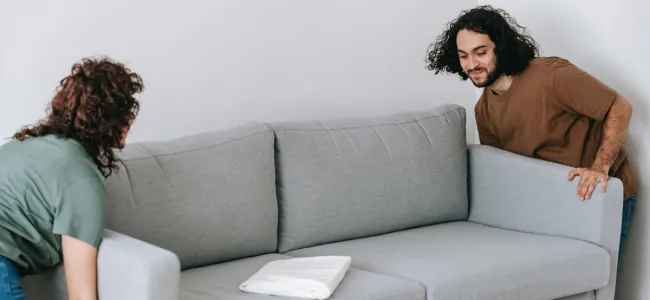 How to Get Rid of an Old Sofa: Sell, Donate, Recycle or Haul AwayWays to get rid of an old sofa: selling, giving it away, donating, recycling, bulk pickup, junk removal and haul-away, plus how to prepare and move it.
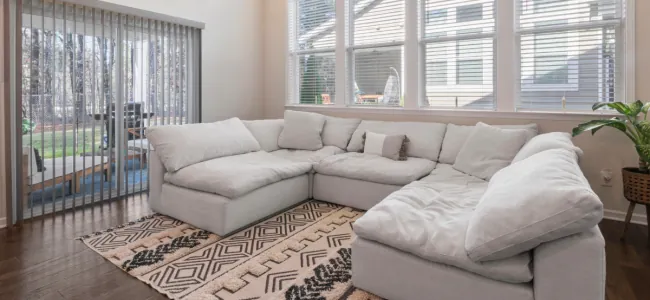 How to Separate a Sectional Sofa (and Put It Back Together)How to separate a sectional sofa: identify the connectors, release them without damage, free stuck clips, and reconnect the pieces so they stay put.
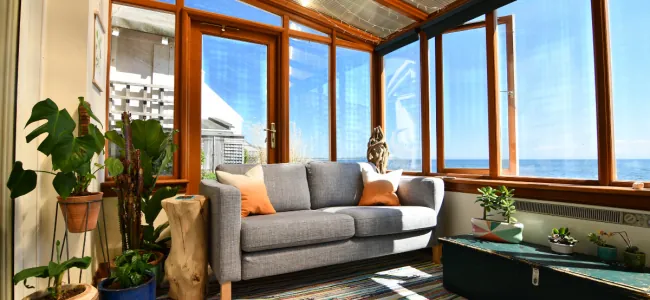 How to Replace Sofa Legs (Thread Sizes, Height and Steps)How to replace sofa legs: find the thread size (5/16 in or M8), choose the right height, fit mounting plates if needed and install new legs safely.