In a small living room the sofa is usually the largest piece of furniture, so it decides how big the room feels. The goal is not to buy the smallest sofa you can find, but one that seats the people who live there, leaves enough space to walk and looks light. This guide covers the measurements and design details that make the biggest difference.
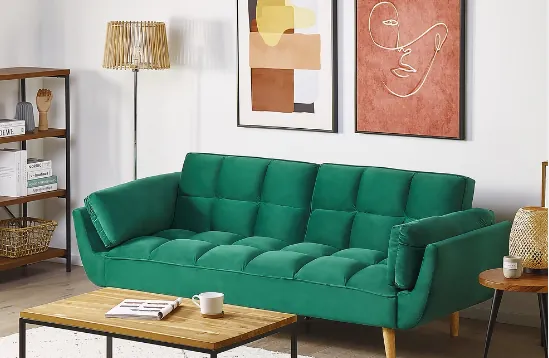
Start with the right size
Furniture makers use different names, but these are the usual size classes:
| Name | Typical width | Seats |
|---|---|---|
| Settee or two-seater | 52–68 in (132–173 cm) | 2 |
| Loveseat | 58–72 in (147–183 cm) | 2 |
| Apartment sofa | 68–80 in (173–203 cm) | 2–3 |
| Standard sofa | 80–90 in (203–229 cm) | 3 |
A simple rule for proportion: the sofa should take up no more than about two-thirds of the wall it stands against. That leaves space for a side table or a plant and keeps the wall from looking crammed.
Depth matters as much as width. Standard sofas are often 36 to 40 inches (91–102 cm) deep. For a small room, look for an overall depth of 30 to 34 inches (76–86 cm). Keep 30 inches (76 cm) of walking space in front of it, or about 14 to 18 inches (36–46 cm) to a coffee table.
Details that make a sofa look smaller
- Thin or no arms. Track arms or slim arms save 6 to 12 inches (15–30 cm) of width compared with rolled or padded arms, without losing seat width. An armless sofa saves even more.
- Raised legs. When you can see the floor under the sofa, the room looks bigger. Legs of 4 to 6 inches (10–15 cm) also make vacuuming easier.
- Tight back. A tight back (upholstered without loose back cushions) is slimmer and keeps its shape. Loose back cushions are softer but add depth.
- Low back. A lower back keeps sight lines open, which helps in rooms where the sofa stands in front of a window or divides an open space.
- Light or wall-matching color. A sofa in a color close to the walls blends in. Dark or strongly patterned sofas draw the eye and look heavier.
Seat depth and comfort
Compact sofas sometimes save space by making the seat shallow. A seat depth of 20 to 22 inches (51–56 cm) suits most adults who sit upright. Tall people, or anyone who likes to tuck their legs up, will prefer 22 to 24 inches (56–61 cm). Check the seat height too: 17 to 19 inches (43–48 cm) is a comfortable standard. If you can, sit on the model in a store for a few minutes before buying.
Multifunctional options
- Sleeper sofa: useful if the living room doubles as a guest room. Check the mattress size and the space you need when it is unfolded (often 80 to 90 inches / 203–229 cm from the back of the sofa). Read more in our article on sleeper sofas.
- Reversible chaise: a compact sofa with a chaise that can be placed on either side, so it still fits if you move.
- Storage: some small sofas have storage under the seat or in an ottoman. It is practical, but lift-up seats often have thinner cushions.
- Modular pieces: two armless chairs and a small corner can become a sofa now and separate chairs later.
Will it fit through the door?
Small apartments often have narrow entrances, tight stairwells and elevators. Measure the delivery route before you order. The key measurement is the sofa's diagonal depth: a sofa can usually be tilted through a doorway that is wider than its diagonal depth, even when the door is narrower than the sofa's overall depth. Our guide on how to measure for a sofa explains how to measure it. Sofas with removable legs and arms, or sofas delivered flat-packed, are easier to get into small homes.
What to avoid
- A large sectional in a room with only one free wall. It will block the walkway.
- Very deep, overstuffed sofas. They look comfortable in a showroom but fill a small room.
- Buying on width alone. Check depth, seat depth and the delivery route as well.
- Skirted bases in a room that already feels dark; legs make the space feel lighter.
Thinking about a corner piece after all? Compare the options in sectional vs sofa, or see more ideas in space-saving small sofas.