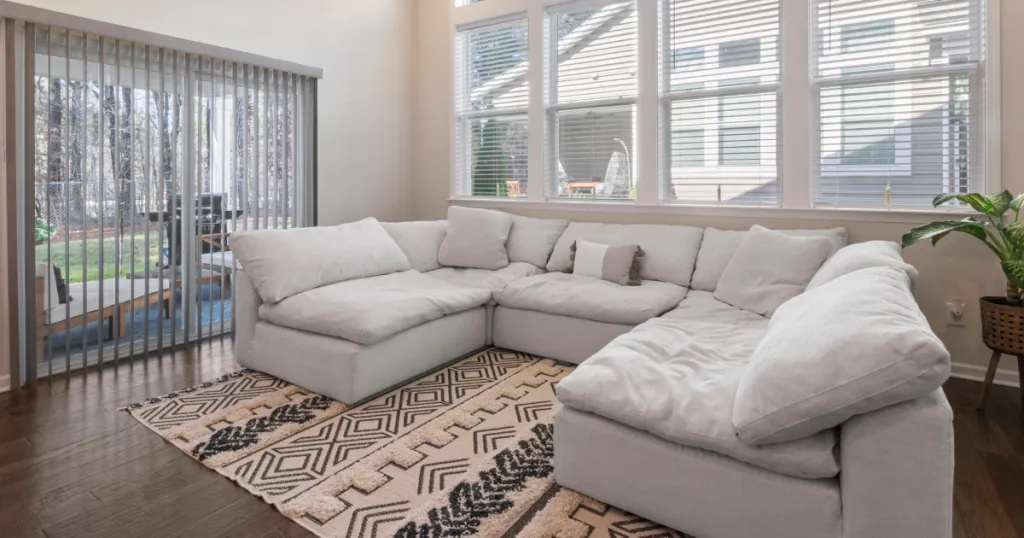
A sectional and a standard sofa can seat the same number of people, but they behave very differently in a room. A sectional wraps around a corner or forms a U and turns the seating area into one unit. A sofa is a single straight piece that you can combine with chairs, a loveseat or an ottoman. Which one is better depends less on style than on the shape of your room, how you use it and how often you move house.
The short answer
- Choose a sectional if you have an open-plan room or a large living room, you regularly seat four or more people, you like to lie down while watching TV, and you want the seating to define a zone in the room.
- Choose a sofa if your room has several doors or windows that break up the walls, you rent or move often, you want to rearrange the furniture, or you need to fit the seating through narrow doorways and stairwells.
What counts as a sectional?
A sectional is any sofa made of two or more pieces that join together. The most common shapes are:
- L-shaped sectional: two sections meeting at a corner seat. It fits into a room corner or floats in an open space with its back towards a dining area.
- Chaise sectional: a sofa with one extended seat (the chaise) for stretching out. It takes less floor space than a full L-shape.
- U-shaped sectional: three sides of seating, usually with two corners or two chaises. It needs a large room and works best facing a TV or fireplace.
- Modular sectional: separate units (armless chairs, corners, ottomans) that you can rearrange, extend or split into a sofa and chair later.
When you order an L-shape or chaise sectional you will see the terms RAF and LAF: right-arm facing and left-arm facing. They describe which side the arm is on when you stand facing the piece, not when you sit on it. Mixing these up is one of the most common ordering mistakes.
Floor space: how much room each one needs
Typical sizes vary by brand, so always check the product measurements, but these ranges help with a first plan:
| Type | Typical width | Typical depth | Seats |
|---|---|---|---|
| Standard 3-seat sofa | 72–90 in (183–229 cm) | 32–40 in (81–102 cm) | 3 |
| Sofa with chaise | 80–100 in (203–254 cm) | 60–70 in at the chaise (152–178 cm) | 3–4 |
| L-shaped sectional | 90–120 in per side (229–305 cm) | 32–40 in (81–102 cm) | 4–6 |
| U-shaped sectional | 110–150 in (279–381 cm) | 80–110 in (203–279 cm) | 6–8 |
Leave at least 30 to 36 inches (76–91 cm) for walkways and about 14 to 18 inches (36–46 cm) between the seat and a coffee table. A sectional that blocks a walkway or a door swing will feel cramped no matter how comfortable it is. Our guide on how to measure for a sofa shows how to tape out the shape on the floor before you buy.
Seating and comfort
A sectional usually seats more people in the same width because the corner adds a seat without adding another arm. It also gives everyone a place to put their feet up on a chaise. The trade-off is the corner seat itself: on many sectionals it is deep and awkward to sit upright in, so check its depth if you plan to use it every day.
A sofa combined with one or two armchairs seats about the same number of people and lets guests face each other, which many people find better for conversation. Chairs can also be moved closer to the fireplace or a window when needed.
Room layout
- Open-plan rooms: a sectional creates a clear living area. Float it with the back facing the dining or kitchen zone and put a console table behind it.
- Square rooms: an L-shape in one corner leaves the rest of the room open. A U-shape usually only works if the room is wider than about 13 feet (4 m).
- Long, narrow rooms: a straight sofa against the long wall with a chair opposite often works better than a sectional that eats into the walkway.
- Rooms with many doors or a radiator in the corner: a sofa is easier, because a sectional needs one uninterrupted corner.
Moving, delivery and future rooms
This is where a standard sofa usually wins. A sectional is designed for one specific room: the side lengths and the arm position (RAF or LAF) may not suit your next home. Large sections can also be difficult to carry up narrow stairs. If you expect to move within a few years, a modular sectional or a sofa plus loveseat is the safer choice, because the pieces can be used separately.
Before ordering any large piece, measure every doorway, hallway and stairwell on the delivery route. Many sectionals ship as separate pieces, which helps, but a single long section can still be the problem.
Cost
For the same quality of frame, cushions and upholstery, a sectional costs more than a sofa simply because it uses more material. Compare like with like: a cheap sectional often saves money on exactly the parts that matter most, such as the frame and seat cushions. What to look for is explained in our sofa construction guide. A good sofa plus a separate chair can be a better use of the same budget.
Quick checklist
- Do you have one uninterrupted corner, or an open area where seating can float? If not, choose a sofa.
- Do you regularly seat more than three people? If yes, a sectional or a sofa plus chairs.
- Will you move within three years? If yes, a sofa or a modular sectional.
- Does the whole piece fit through your doorways and stairs? Check each section's width, height and depth.
- Have you checked RAF and LAF on the order? Stand facing the piece and decide where the chaise or corner goes.
Still undecided? Read how to make the most of your space with a sectional, or see our tips for sofas in small spaces if your room is on the compact side.