Most sectional sofas come apart in a few minutes. The pieces are held together by connectors near the bottom of the frame, usually interlocking metal clips that release when you lift one section straight up by an inch or two. The trick is knowing which connector you have, so you lift instead of pull and don't bend the hardware.
Below: the common connector types, how to separate and reconnect the pieces, and how to free a stuck connector.
Key points
- Take off the cushions and look along the bottom of the seam between two sections: that is where most connectors sit.
- Alligator-style clips release when you lift one section straight up about 1–2 in (2.5–5 cm). Pulling sideways bends them.
- Bracket and bolt connectors need a screwdriver or wrench. Power reclining sectionals also have cables between the pieces, so unplug first.
- Work with two people and carry the sections. Dragging stresses the legs and frame joints.
- Bag and label the hardware so you can reconnect the sofa later.
In this guide
- Before you start: will the pieces work on their own?
- Common sectional connector types
- How to separate a sectional sofa, step by step
- How to unhook a stuck sectional connector
- How to reconnect a sectional sofa
- How to keep sectional pieces from separating
- Ways to use a separated sectional
- Separating a sectional to move or clean it
- Frequently asked questions
Before you start: will the pieces work on their own?
Sectional pieces are designed to sit side by side, so not every piece looks finished alone. Check each one before you plan a new layout:
- Arms. End pieces are labeled RAF or LAF (right-arm or left-arm facing, as seen when you stand in front of the sofa). With an arm on one side only, the open side can look unfinished. Two end pieces pushed together often make a neat loveseat.
- Corners. A square corner seat can work as an oversized accent chair. A wedge-shaped corner rarely looks right on its own.
- Backs. If a piece will float in the room, check that its back is upholstered in the same fabric, not a plain lining.
- Chaise and ottoman. A chaise works well alone as a reading lounger, and an ottoman can become a coffee table or extra seat.
Plan where every section will go before you take the sofa apart, so you only move it once. Our guide on how to measure for a sofa shows how to tape out shapes on the floor first.
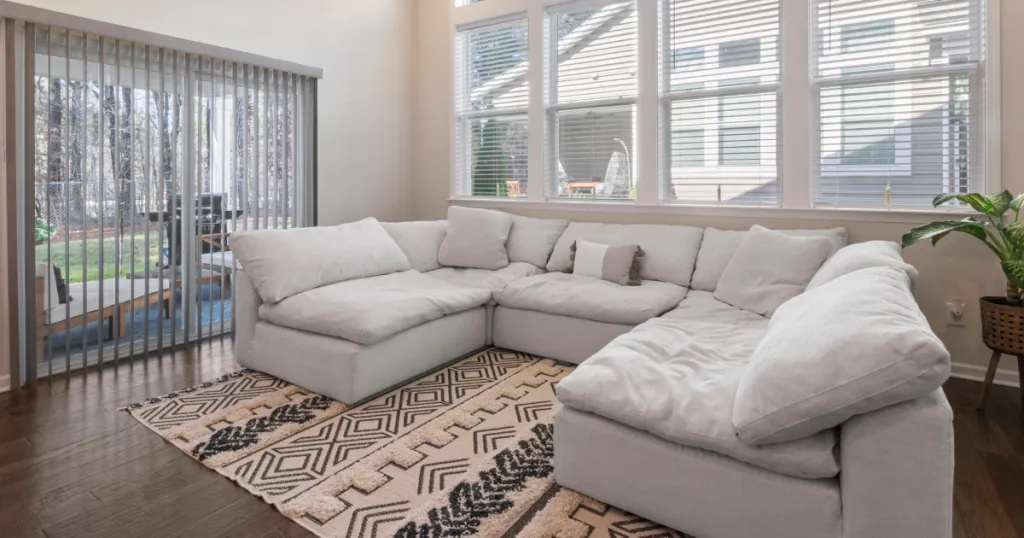
Common sectional connector types
| Connector | What it looks like | How to release it |
|---|---|---|
| Alligator clip | Two toothed or hooked metal plates, one on each section, that interlock | Lift one section straight up about 1–2 in (2.5–5 cm) |
| Pin and slot | A metal pin on one section that drops into a slotted bracket on the other | Lift the section with the pin up and out |
| Hook bracket | A hook that drops into a loop or bracket on the other section | Lift, sometimes after tilting slightly |
| Bolted bracket | A flat or L-shaped plate screwed or bolted across both frames | Remove the screws or bolts |
| Straps or hook-and-loop tabs | Fabric straps with buckles, or hook-and-loop strips, under the seats | Unbuckle or peel apart |
| No connector | Some modular sofas rely on weight and grip pads | Simply lift the piece away |
Most joints have two connectors, one near the front and one near the back, so check the whole seam. Power reclining sectionals also have cables running between the sections, often to a junction box under a seat.
How to separate a sectional sofa, step by step
- Clear the sofa. Remove the cushions, throws and anything stored underneath. You'll see the seam better, and the sections get lighter.
- Unplug power features. On a power reclining sectional, unplug the main cord from the wall first, then disconnect the cables between sections. Photograph where each one goes.
- Find every connector. Shine a flashlight into the seam from above, then look underneath. If you can't see the hardware, tilt one section back carefully with a helper.
- Identify the type. Match it to the table above. Remove any screws or bolts and put them in a zip bag.
- Lift, don't pull. For clips, pins and hooks, one person steadies the piece that stays while the other lifts the neighboring section straight up about 1–2 in (2.5–5 cm) at the end nearest the joint, then moves it away.
- Carry each piece. Lift sections by the frame, not the arms or back cushions. Dragging can snap a leg, loosen frame joints and scratch the floor.
- Label the hardware. Tape the bag of screws under the matching section, or write on it which joint it belongs to.
Tip: Photograph each connector before you release it. It makes reconnecting much faster, especially when a piece only fits one way.
How to unhook a stuck sectional connector
Connectors that won't let go are usually under tension: the sofa has settled, the sections sit at slightly different heights, or a clip is bent. Try these fixes in order:
- Take all the weight off. Remove every cushion and make sure nobody is sitting on either piece.
- Push before you lift. Press the two sections firmly together first. This takes the strain off the hooks so they slide apart as you lift.
- Lift the other section. Only one half of most connectors needs to rise. If one piece won't budge, try its neighbor.
- Tilt instead. Raise the back edge first, then the front, so one connector releases at a time.
- Tap it free. Hold a small wood block against the bottom edge of the upper clip and tap upward gently with a rubber mallet.
- Look for a locking screw. Some clips are also screwed through a slot.
Avoid: prying between the frames with a crowbar or yanking the sections apart sideways. Force can tear the connector's screws out of the wood, and stripped screw holes are much harder to fix than a stuck clip.
A bent clip can often be straightened with pliers. If it is cracked or badly twisted, replace it with an inexpensive universal sectional connector, matching the hole spacing of the old one.
How to reconnect a sectional sofa
- Bring the pieces close. Set them roughly in position, a few inches apart, with the connectors facing each other.
- Check the height. Both sections must sit level. If one is lower because of a worn glide, a loose leg or an uneven floor, fix that first. Mismatched heights are the main reason clips won't engage. Our guide on how to replace sofa legs helps if a leg is damaged.
- Line up the front edges. The seat fronts should form one straight line.
- Lower the connector into place. Lift the section with the upper half of the clip, slide it against its neighbor and lower it until you feel the clip seat.
- Refit screws and cables. Put bolted brackets back in their original holes, snug but not overtightened. Reconnect the cables between sections, plug in at the wall and test every recliner.
- Test the joint. Push gently on each piece. There should be no gap and no movement at the seam.
How to keep sectional pieces from separating
Sections drift apart when connectors are worn or missing, or on smooth floors. These fixes help:
- Tighten the connector screws. If a screw spins without gripping, replace it with a slightly thicker or longer wood screw that bites into solid frame.
- Add connectors. If a joint has only one clip, add a second at the other end of the seam.
- Use sectional clamps. Universal U-shaped clamps hook over two neighboring legs or frame rails, with no drilling.
- Stop the sliding. Rubber grippers under the legs, or a large rug on a non-slip pad, keep pieces from creeping on hard floors.
- Strap it underneath. A heavy-duty zip tie or furniture strap around two frame rails is an invisible stopgap until a missing connector is replaced.
Ways to use a separated sectional
Conversation layout
Two sections facing each other across a coffee table suit talking and entertaining better than a TV-focused L-shape.
Sofa plus big chair
Join the two end pieces as a compact sofa and angle the corner seat toward it as an oversized armchair.
Reading nook
Move the chaise to a window with a floor lamp and side table, away from the main seating area.
Two rooms
Split a large sectional between the living room and a den, office or guest room.

For more arrangements, from floating layouts to U-shapes, see our sectional sofa layout ideas, or our tips on sofas for small spaces if your room is compact.
Pros of splitting
- Flexible seating you can change by season or occasion
- Wider walkways and a more open room
- Pieces fit through doors and up stairs when you move
Cons of splitting
- One-arm pieces and wedges can look unfinished alone
- Pieces may drift unless you anchor them
- Connectors wear if you separate the sofa often
Separating a sectional to move or clean it
For a move, wrap each piece in a moving blanket and check doorways and stairwells against the largest section. Unscrewing the legs gains a few inches. Lift power sections by the frame, never the footrest; our reclining sofa guide explains the mechanisms.
While the sofa is apart, vacuum the seams and frame, where crumbs and pet hair collect, then follow our guide on how to clean a fabric sofa. It is also a good moment to check for loose frame joints; our sofa construction guide shows what a sound frame looks like.
Frequently asked questions
Can all sectional sofas be separated?
Most can. Some L-shaped sofas and sofas with a fixed chaise are built on one continuous frame. If you see a seam between two frames with connectors underneath, the pieces are designed to come apart.
How do you separate a sectional with alligator clips?
Remove the cushions, then lift one section straight up about 1–2 in (2.5–5 cm) at the end nearest the joint while someone steadies the other piece. The plates slide apart vertically; pulling sideways only bends them.
Why won't my sectional connectors line up?
Usually the pieces sit at different heights because of an uneven floor, a worn glide or a loose leg. A bent clip or a cushion caught in the seam can also block it. Level the sections first.
What can I use if my sectional connectors are missing?
Universal replacement connectors screw onto the inside of the frame, and clamp-style connectors hook over neighboring legs without drilling. A zip tie around two frame rails works as a temporary fix.
Do power reclining sectionals separate the same way?
The connectors are the same, but unplug the sofa at the wall and disconnect the cables between sections first. Power sections are heavy, so lift them with two people and don't hold the footrest.
Unsure a sectional suits your room? Compare the options in our sectional vs sofa guide, or browse all our sofa guides.
 Coffee Table Height Guide: Size, Distance and End TablesHow tall a coffee table should be next to your sofa, how far away to place it, how long to make it, and how to size end tables and taller tables.
 How to Get Rid of an Old Sofa: Sell, Donate, Recycle or Haul AwayWays to get rid of an old sofa: selling, giving it away, donating, recycling, bulk pickup, junk removal and haul-away, plus how to prepare and move it.
 How to Replace Sofa Legs (Thread Sizes, Height and Steps)How to replace sofa legs: find the thread size (5/16 in or M8), choose the right height, fit mounting plates if needed and install new legs safely.Sectional Sofa Layout Ideas for Every Room ShapeSectional sofa layout ideas for corners, open plans, small rooms, TVs and fireplaces, with walkway clearances, chaise placement and the right rug size.