The best way to get rid of an old sofa depends on its condition. A clean sofa in good shape can be sold or donated, a worn but usable one can be given away for free, and a broken or stained one should go to recycling, your city's bulk pickup or a removal service.
Whatever you choose, plan ahead: charities and bulk pickup often need to be booked days or weeks in advance, and a sofa has to leave the house the same way it came in. This guide walks you through each option and how to prepare the sofa so the handover goes smoothly.
Key points
- Start with the condition: good sofas can be sold or donated, damaged ones need disposal or recycling.
- Most charities refuse sofas with stains, tears, pet damage, smoke odor or any sign of pests.
- Check whether your city offers bulk-item collection before paying for a removal service.
- Ask about haul-away when you order a new sofa: many retailers offer it, sometimes for a fee.
- Clean the sofa, check the crevices and measure the exit route before anyone comes to collect it.
In this guide
- Which option fits your sofa?
- Option 1: sell your sofa
- Option 2: give it away for free
- Option 3: donate your sofa
- Option 4: recycle it
- Option 5: bulk pickup, landfill or a removal service
- Option 6: reuse or repurpose it
- How to prepare the sofa for pickup
- Buying the next one: think about its end of life
- Frequently asked questions
Which option fits your sofa?
Be honest about the condition. Would you be happy to receive this sofa yourself? If not, a charity probably will not want it either.
| Condition | Best options | Effort and cost |
|---|---|---|
| Like new or good, clean, no damage | Sell it, or donate it | Some effort; you may earn money or get a donation receipt |
| Usable but worn or dated | Give it away for free, sell cheaply, or offer to a reuse group | Low effort; the new owner usually collects |
| Broken frame, stains, tears, odors | Recycling, bulk pickup, landfill drop-off | You may pay a fee or need to transport it |
| Any condition, little time | Junk removal service or retailer haul-away | Least effort, highest cost |
| Bed bugs or other pests | Disposal only, following local rules | Never sell, donate or give it away |
Option 1: sell your sofa

Selling is worth the effort if the sofa is in good condition, especially if it is a recognizable design, real leather, a sleeper, a sectional that is easy to split, or only a few years old. Used sofas usually sell for a fraction of the original price, so set your expectations accordingly.
How to price a used sofa
- Look at comparable listings. Search local marketplace sites for similar sofas in your area and note what they ask. Pay attention to how long listings stay up: a sofa that has been listed for weeks is overpriced.
- Factor in age and condition. Fading, pilling, sagging cushions and scratches all lower the value. A sofa with a removable, washable cover or spare fabric is worth more.
- Leave a little room. Many buyers will try to negotiate, so price slightly above the amount you will accept.
- Lower it if nothing happens. If you get no serious messages within a week or so, drop the price. Speed often matters more than the last few dollars.
Clean it and take good photos
- Clean first. Vacuum the cushions and crevices, wipe the frame and legs, and treat any marks. Follow our guides to cleaning a fabric sofa or cleaning a leather sofa.
- Clear the space. Move clutter away from the sofa. A plain wall behind it looks best. A throw or a couple of cushions can make it look inviting, but do not use them to hide damage.
- Use daylight. Shoot during the day with the lights on and the curtains open. Avoid flash.
- Show every angle. Take the front, both sides, the back and a close-up of the fabric or leather. Include details such as tufting, nailhead trim or a pull-out bed.
- Photograph the flaws. A close-up of a small scuff builds trust and avoids arguments at pickup.
Write a clear listing
Include the overall width, depth and height, the material, the age, the brand or model if you know it, and the honest condition. Mention whether it comes from a smoke-free or pet-free home, but only if that is true. Use the words buyers will search for, such as "three-seater", "sectional", "sleeper sofa", "leather" or the color. State that the buyer must collect, and whether you can help carry it.
Where to list it
You do not need to pay to advertise a sofa. These types of places reach local buyers for free or for a small fee:
- Local online marketplaces and classified sites, where most used furniture is bought and sold.
- Neighborhood apps and community buy-and-sell groups, which reach people close by who can collect easily.
- Consignment stores and resale sites for furniture, which handle the sale for a share of the price. They tend to accept only better-quality or designer pieces.
- Friends, family and colleagues, who may know someone furnishing a first apartment.
Posting on more than one platform increases your chances. Keep the details consistent, answer messages quickly and remove the listing everywhere once it is sold.
Avoid: buyers who offer to pay more than your asking price, ask you to refund the difference, or want to arrange their own "shipping company". These are common scams. Accept cash or a secure payment method at pickup, and have someone with you when strangers visit.
Option 2: give it away for free
If the sofa is usable but not worth much, giving it away is often the quickest solution. Free listings on local marketplaces, community reuse groups and neighborhood apps attract plenty of interest, and the person who takes it does the carrying. Be clear about the condition and the measurements, set a pickup time, and do not leave the sofa on the curb unless your city allows it: many places treat that as illegal dumping.
Option 3: donate your sofa
Donating keeps a good sofa out of landfill and helps someone who needs it. Many types of organizations accept furniture:
Thrift and charity stores
Sell donated furniture to fund their work. Some collect from your home, others require drop-off.
Furniture banks
Give furniture directly to families leaving homelessness, domestic violence or disaster situations.
Shelters and housing programs
May need sofas for residences or to help people setting up a new home. Call first: their needs change.
Religious and community groups
Often know local families who need furniture and can match your sofa to them.
What charities usually accept
Rules vary, but most organizations turn down upholstered furniture that has:
- stains, rips, burns or worn-through fabric
- a broken or wobbly frame, or sagging seats
- pet hair, pet damage or strong odors, including smoke
- any sign of bed bugs or other pests
- missing cushions or parts
Some organizations also ask for the manufacturer's label to be attached. In the UK, for example, charity shops generally cannot accept upholstered furniture without its permanent fire safety label. Send clear photos when you book, so the charity can say yes or no before the truck arrives.
Tip: Book early. Free charity pickups are popular and are often scheduled one or more weeks ahead. In the US, ask for a receipt: if you itemize deductions, a donation to a qualifying charity may be deductible at its fair market value, not the price you paid. Check current tax rules or ask a tax professional.
Option 4: recycle it
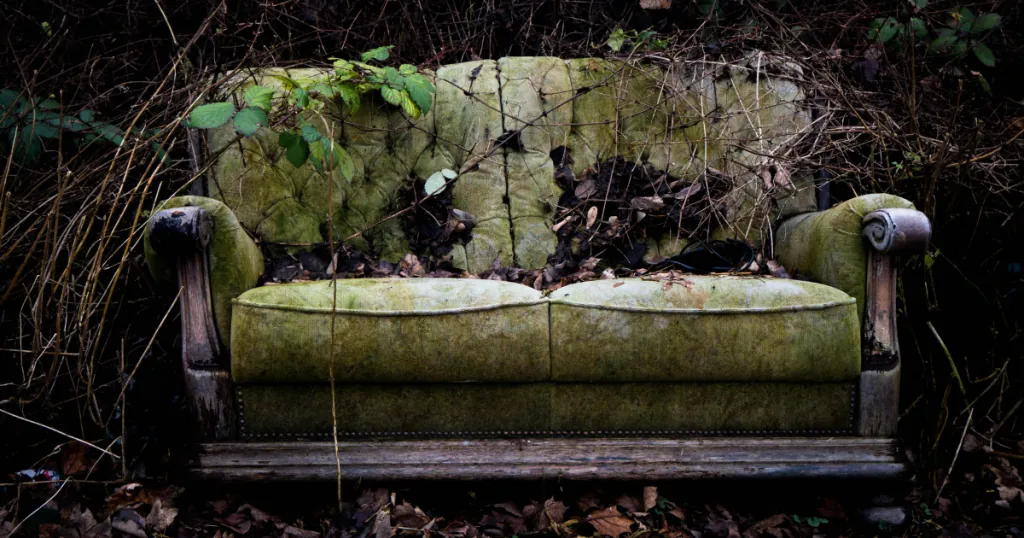
Sofas are harder to recycle than most household items because they combine wood, metal springs, foam, fabric or leather, staples and glue. Still, the materials can be separated: wood can be chipped or reused, metal springs are valuable scrap, and foam can be turned into products such as carpet padding.
- Ask your city or county. Some waste departments run furniture or bulky-waste recycling, or can point you to a facility that takes sofas.
- Look for specialty recyclers. In some areas, mattress and furniture recyclers dismantle sofas for a fee.
- Separate it yourself. If you take the sofa apart, the metal can usually go to a scrap yard and clean wood to a recycling center, leaving only the fabric and foam for the trash.
Avoid: cutting into a sofa without protection. Springs can be under tension and snap back, and the frame is full of staples and nails. Wear heavy gloves and safety glasses, and be careful with sleeper sofa mechanisms, which have strong springs and pinch points.
Option 5: bulk pickup, landfill or a removal service
City bulk-item collection
Many towns collect large items such as sofas, either on fixed days or by appointment. Some do it for free a few times a year, others charge a fee per item. Check the rules on your city's website: you may need to book in advance, put the sofa out only the night before, and in some places wrap upholstered items in plastic to prevent pests from spreading.
Drop-off at a transfer station or landfill
If you have a truck or trailer and help, you can usually take the sofa to a local transfer station or landfill yourself. Expect a fee based on the item or the weight.
Junk removal services
Junk removal companies collect from inside your home, carry the sofa out and take it away, often the same or the next day. Prices are usually based on how much space your items take up in the truck. Ask whether they donate or recycle what they can, and get a price before they start loading.
Pros of a removal service
- No lifting or transport on your part
- Often available within a day or two
- Can take other unwanted items in the same trip
- Many sort out items for donation or recycling
Cons
- The most expensive way to get rid of a sofa
- Prices vary widely, so compare quotes
- What happens to the sofa afterward is not always clear
Haul-away with a new sofa
If you are buying a new sofa, ask the retailer whether the delivery team can take the old one away. Many offer this service, sometimes free and sometimes for a fee, but it usually has to be booked with your order. Conditions often apply: the sofa may need to be emptied, accessible and free of pests, and some retailers only take an item similar to the one they deliver. If you are shopping now, our guide to buying a sofa online explains what to check in the delivery options.
Option 6: reuse or repurpose it
Before you get rid of a sofa, ask whether it really needs to go. A sturdy frame with tired fabric can be reupholstered or covered with a slipcover, and flat cushions can be refilled or replaced. Our guides on how long a sofa lasts and on sofa slipcovers help you decide.
If the sofa itself has to go, parts of it can live on. Seat cushions in good condition can become floor cushions or a base for a pet bed. Undamaged fabric or leather from the back panels can cover a small footstool or seat pad. Wood from a solid frame can be reused for simple projects if you are handy with tools.
How to prepare the sofa for pickup
- Empty it. Remove all cushions and check the crevices and under the seat deck for coins, remotes, jewelry and toys.
- Clean it. Vacuum and wipe it down. A clean sofa sells faster and is more likely to be accepted by a charity.
- Remove the legs. Most legs unscrew by hand, and removing them gains a few inches in doorways. See our guide to replacing sofa legs for how they are attached. Tape the screws and hardware to the underside.
- Separate modular pieces. Unclip sectional pieces and move them one at a time. Our guide on how to separate a sectional shows how the connectors work.
- Measure the route. Measure doorways, hallways and stair turns. A sofa that came in will usually go out again, but often only at the same angle, such as stood on end.
- Protect the house. Wrap the sofa in moving blankets or plastic, cover the corners of door frames, and clear the path.
- Lift safely. Use at least two people, lift with your legs, and lock or tie a sleeper mechanism so it cannot open while you carry it.
Buying the next one: think about its end of life
The easiest sofa to get rid of is one that lasts. A solid frame, a good spring system and replaceable cushions mean you can repair rather than replace; our guide to sofa construction explains what to look for. Removable, washable covers extend the life of the upholstery. If sustainability matters to you, certifications can help: FSC certification indicates wood from responsibly managed forests, and GOTS certification covers organic textiles. Natural fabrics such as cotton, linen and wool are another option to consider.
Frequently asked questions
Will a charity pick up my sofa for free?
Many charities and thrift stores offer free pickup for furniture in good condition, but not all, and schedules fill up quickly. Most will ask for photos first and will refuse sofas with stains, tears, odors or pest damage.
Can I put my sofa out with the regular trash?
Usually not as a whole item. Most cities handle sofas through bulk-item collection, which may need to be booked and may cost a fee. Check your local rules, as leaving furniture on the curb without permission can lead to a fine.
How much is my used sofa worth?
Usually a fraction of what you paid, depending on age, condition, material and demand. Check what similar sofas are listed for locally, and lower your price if you get no serious interest within a week or so.
What do I do with a sofa that has bed bugs?
Do not sell, donate or give it away. Contact a pest control professional, then follow your city's rules for disposal, which may include wrapping the sofa in plastic and marking it so nobody takes it home.
Can a sofa be recycled?
Yes, partly. The wood, metal springs and sometimes foam can be recycled, but not every area has a facility that takes whole sofas. Ask your local waste department or look for a furniture or mattress recycler nearby.
Getting rid of the old sofa is often the first step toward a new one. If you are about to choose a replacement, start with how to measure for a sofa so the new one fits through the same door.
 Coffee Table Height Guide: Size, Distance and End TablesHow tall a coffee table should be next to your sofa, how far away to place it, how long to make it, and how to size end tables and taller tables.
 How to Separate a Sectional Sofa (and Put It Back Together)How to separate a sectional sofa: identify the connectors, release them without damage, free stuck clips, and reconnect the pieces so they stay put.
 How to Replace Sofa Legs (Thread Sizes, Height and Steps)How to replace sofa legs: find the thread size (5/16 in or M8), choose the right height, fit mounting plates if needed and install new legs safely.Sectional Sofa Layout Ideas for Every Room ShapeSectional sofa layout ideas for corners, open plans, small rooms, TVs and fireplaces, with walkway clearances, chaise placement and the right rug size.