The best sofa for a short person has a shallow seat, ideally about 19–21 in (48–53 cm) deep, and a seat height of roughly 15–17 in (38–43 cm), so you can sit all the way back with your feet flat on the floor. Most standard sofas are built around an average-height adult, with seats 21–24 in (53–61 cm) deep and 17–19 in (43–48 cm) high, which leaves shorter people perched on the edge or slouched against the back with their feet dangling.
The good news is that the right sofa is easy to find once you know which numbers to check, and a sofa that is too deep can usually be fixed with a few cushions. This guide gives you the measurements, the styles that tend to fit, and the fixes that work.
Key points
- Seat depth matters most: look for about 19–21 in (48–53 cm), and avoid "deep-seat" sofas of 24 in (61 cm) or more.
- A seat height around 15–17 in (38–43 cm) lets most people under about 5'3" (160 cm) keep their feet on the floor.
- Measure your own legs: your knee height and thigh length tell you more than your overall height.
- Tight-back, mid-century and apartment-size sofas often fit shorter people well.
- A too-deep sofa can be fixed with firm back pillows, a bolster and a footstool.
In this guide
- Why standard sofas feel wrong when you are short
- Seat depth and seat height: the numbers to look for
- How to measure what fits you
- Back height, arm height and cushions
- Sofa styles that work for short people
- How to fix a sofa that is too deep or too high
- When you share the sofa with someone taller
- Buying online when you are short
- Frequently asked questions
Why standard sofas feel wrong when you are short
When the seat is deeper than your thighs are long, you have two bad choices. You sit forward so your knees can bend at the front edge, and your back has no support. Or you sit all the way back, your legs stick out straight, and you slide into a slouch. Add a seat that is a little too high and your feet do not reach the floor, so the front edge presses into the backs of your thighs.
Many shorter people end up sitting cross-legged or with their legs tucked under them simply because there is nowhere else to put them. That can be comfortable for a while, but a sofa that actually fits lets you sit back and relax properly.
Seat depth and seat height: the numbers to look for
Use the table as a starting point. Leg length varies a lot between people of the same height, so the measuring method in the next section is more accurate.
| Your height | Seat depth to look for | Seat height to look for |
|---|---|---|
| Under 5'2" (157 cm) | 19–20 in (48–51 cm) | 15–17 in (38–43 cm) |
| 5'2"–5'5" (157–165 cm) | 20–21 in (51–53 cm) | 16–18 in (41–46 cm) |
| 5'6"–5'10" (168–178 cm), for comparison | 21–23 in (53–58 cm) | 17–19 in (43–48 cm) |
Seat depth vs overall depth
Product listings often give the overall depth, from the very front to the back of the frame, which is typically 32–40 in (81–102 cm). That is not the number you need. Seat depth is measured from the front edge of the seat cushion to the face of the back cushion. Some retailers measure it to the back frame with the back cushions removed, which makes the seat look deeper than it feels, so ask how they measured it. Our guide to standard sofa dimensions explains each measurement.
Seat height and cushion sink
Seat height is measured from the floor to the top of the seat cushion. Soft cushions sink by an inch or two (2.5–5 cm) when you sit down, so a slightly higher listed seat height can still work if the cushions are soft. Firm seats stay closer to the listed number.
How to measure what fits you
Five minutes with a tape measure gives you your own numbers, which work better than any chart.
- Sit on a firm dining chair. Sit all the way back, with your feet flat on the floor and your knees bent at about a right angle. Wear the shoes or slippers you usually wear at home.
- Measure your knee height. Measure from the floor to the crease behind your knee. A sofa with a listed seat height up to about 1 in (2.5 cm) above this number will usually let your feet rest flat once the cushion sinks.
- Measure your thigh length. Measure from the chair back (where your bottom touches it) to the crease behind your knee.
- Subtract 2–3 in (5–8 cm). That is the seat depth that lets you sit fully back with a little gap behind your knees.
- Compare with the listings. Few sofas are that shallow, so note the difference. That gap is what you will fill with back pillows, so a smaller gap means fewer cushions.
It also helps to measure your current sofa so you know exactly what feels wrong; our guide on how to measure for a sofa shows where to put the tape.
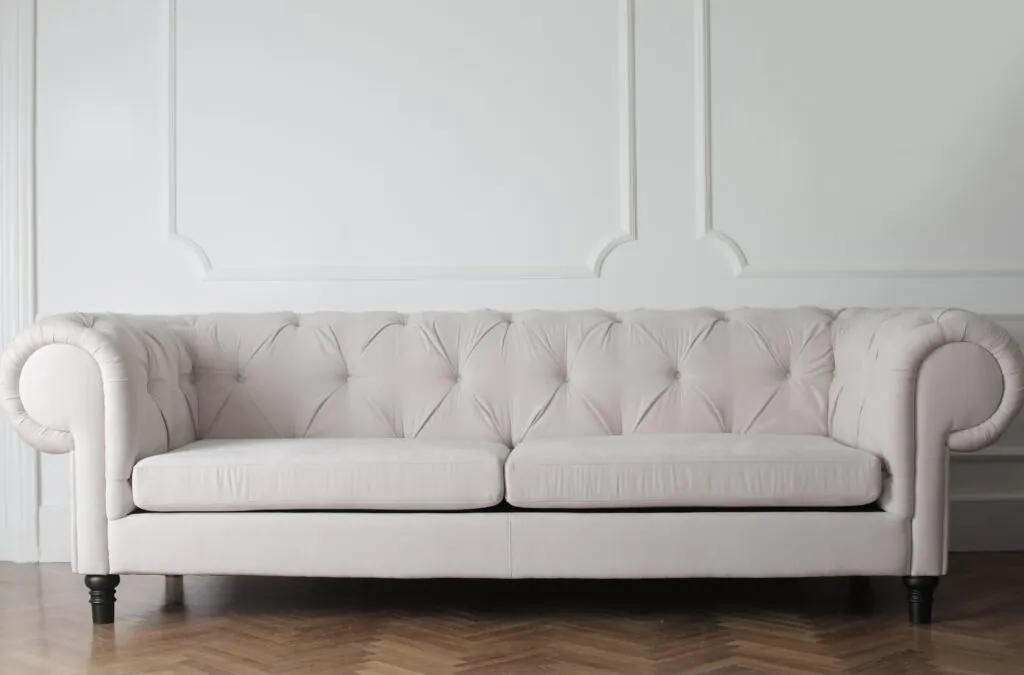
Back height, arm height and cushions
Back height
Low-back sofas, often around 28–32 in (71–81 cm) overall, suit shorter people well for upright sitting, because the back still reaches your shoulder blades. If you like to rest your head, though, you will need a higher back, a headrest pillow, or a sofa with adjustable headrests, which some modular and power-reclining designs have.
Arm height
Arms on many sofas sit around 23–27 in (58–69 cm) from the floor. Lower arms of about 22–24 in (56–61 cm) are easier to rest an elbow on without hunching your shoulders. Slim track arms also keep the overall width down, which helps in a small room.
Cushions and firmness
A medium to medium-firm seat works best for most shorter people. Very soft, down-filled seats let you sink and slide backward, which makes the seat feel even deeper. The back cushions are where you can be flexible: loose pillow backs can be swapped, stacked or plumped to change the depth.
Tight back: pros
- Seat depth stays the same and is often shallower.
- Firm, upright support that does not slump.
- Neat look with no cushions to straighten.
Tight back: cons
- You cannot remove a cushion to make room for taller people.
- Less sink-in feel for lounging.
- Harder to reupholster or refill at home.
Loose pillow-back sofas are the opposite: more adjustable and softer, but the depth changes as the pillows compress, and they need regular plumping.
Sofa styles that work for short people
Some styles are more likely to have a shallow, upright seat. Always check the actual measurements, because sizes vary widely within each style. Our sofa styles guide describes each look in more detail.
Mid-century modern
Slim cushions, tight or semi-attached backs, raised legs and shallow seats. Often one of the best fits for shorter people.
Apartment-size sofas
Built for small rooms, so they usually have a reduced overall depth as well as length. See our guide to sofas for small spaces.
Loveseats and settees
Often more upright and compact than full sofas. Compare sizes in our guide to a loveseat vs a sofa.
Chaise sectionals
A chaise lets you sit back with your legs fully supported, which solves the deep-seat problem in a different way.
Styles to check carefully
- Deep-seat and "cloud" sofas: seats of 24–30 in (61–76 cm) are designed for lounging and are the hardest to sit upright on.
- Oversized rolled-arm sofas: wide, high arms push the shoulders up and add depth.
- Sleeper sofas: the hidden mechanism can make the seat higher or firmer than it looks.
- Recliners: check where the leg rest ends. If your legs are shorter than the footrest is designed for, it supports your calves instead of your feet. Some ranges are offered in smaller sizes; our reclining sofa buying guide explains what to check.
How to fix a sofa that is too deep or too high
If you already own a sofa that does not fit, you do not need to replace it. These fixes can be combined until it feels right.
- Measure the gap. Sit fully back and note how far the front edge is from the backs of your knees. That tells you how much depth to remove.
- Add firm back pillows. A row of firm pillows, about 4–6 in (10–15 cm) thick, against the back cushions brings the backrest forward. Firm fillings work better than soft down, which compresses.
- Use a bolster or wedge. A long bolster across the back, or a wedge-shaped backrest cushion, reduces depth evenly and gives lumbar support at the same time.
- Upgrade the back cushion inserts. An upholsterer can fit thicker, firmer inserts in your existing back cushion covers, or make a second set of back cushions.
- Support your feet. If the seat is too high, a footstool or ottoman lets your feet rest so the front edge does not press into your thighs.
- Change the legs. If the sofa has screw-in legs, shorter ones can lower the seat by an inch or more. Our guide to replacing sofa legs shows how.
Tip: Before buying back pillows, test with what you have. Stack bed pillows behind you until the depth feels right, then measure the stack. That is the thickness to shop for.

For more general fixes, such as firmer cushions and lumbar support, see our guide on how to make a sofa more comfortable.
When you share the sofa with someone taller
Couples and families with very different heights rarely find one seat that fits everyone. A few approaches make it easier.
- Choose a loose pillow-back sofa: the shorter person adds an extra back pillow; the taller person removes one.
- Pick a medium depth: about 21–22 in (53–56 cm) is a workable compromise, with a bolster for the shorter person.
- Mix seat types: a sofa plus a smaller armchair, or a sectional with a chaise, gives each person a seat that suits them.
- Consider a power recliner: individual seats can be adjusted to different positions.
Buying online when you are short
Showroom testing is ideal, but if you are buying online, the specification sheet is your best tool. Look for seat depth, seat height and arm height, not just overall dimensions. If any are missing, ask the retailer, and ask how they measured seat depth. Check the return policy before you order, because a sofa that does not fit is expensive to send back. Our guide to buying a sofa online covers what else to check.
Frequently asked questions
What seat depth is best for short people?
For most people under about 5'4" (163 cm), a seat depth of about 19–21 in (48–53 cm) works well. Measure your thigh length and subtract 2–3 in (5–8 cm) for a personal target.
What seat height should a sofa have for a short person?
Roughly 15–17 in (38–43 cm) for people under about 5'2" (157 cm), and 16–18 in (41–46 cm) for those a little taller. Your feet should rest flat on the floor when you sit back.
Are deep-seat sofas bad for short people?
Not bad, but harder to sit upright on. If you love the lounging feel of a deep seat, plan to use firm back pillows or a bolster when you want to sit up.
How can I make my sofa less deep?
Add firm back pillows or a long bolster, use a wedge-shaped backrest cushion, or have an upholsterer make thicker back cushions. A footstool helps if the seat is also too high.
Is a loveseat better than a sofa for short people?
Not automatically, but loveseats and settees are often more upright and compact. Check the seat depth and height, not the overall size.
When the seat depth and height match your legs, a sofa suddenly becomes a place to sit back rather than perch. If back comfort is also a concern, read our guide to the best sofa for back pain.
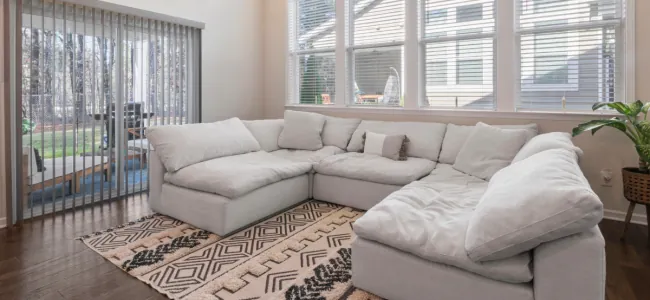 Sectional vs Sofa: Which Is Right for Your Living Room?Sectional or a standard sofa? Compare floor space, seating, room layout, moving and cost, with measurements and a simple checklist to decide.
 Sofas for Small Spaces: How to Choose One That FitsHow to pick a sofa for a small living room or apartment: the right size, arm and leg styles, depth, colors, sleeper and modular options, and what to avoid.
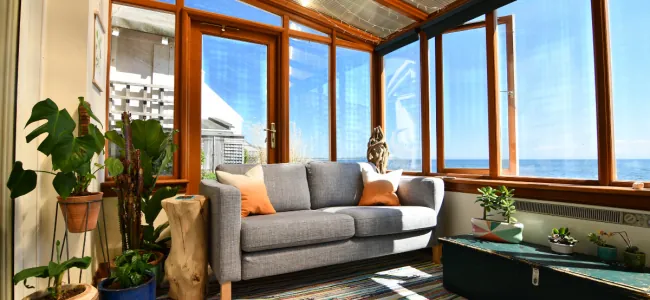 How to Measure for a New Sofa (Room, Doorways and Stairs)Measure your room, doorways, hallways and stairs before buying a sofa. Step-by-step instructions, clearances and the diagonal-depth test for tight doors.
 What Makes a Good Sofa? Frame, Springs and Cushions ExplainedHow to judge sofa quality: frame materials and joints, spring systems, foam density and cushion fills, plus quick tests you can do in a showroom.